Ida-Virumaa
by Tauri Tuvikene
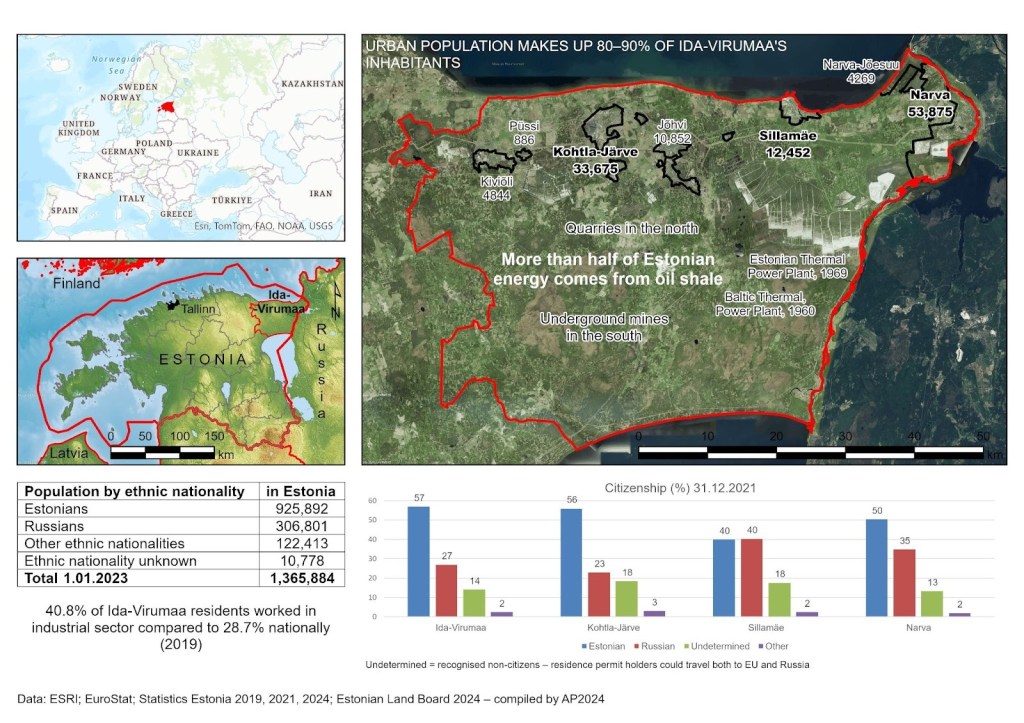
The project focuses on the Ida-Virumaa region, which has undergone multiple crises and is currently marked by pronounced socio-spatial inequalities, warranting special governmental attention. This makes it an apt site for research on transitions and transformations. Situated at the geopolitical border between the European Union (EU) and Russia, the region is shaped by ongoing tensions. As a peripheral region within the broader European periphery, Ida-Virumaa offers a particularly intensive “living laboratory” for such inquiry. It is central to Estonia’s energy independence, as oil shale mining and chemical processing remain key industries. Hosting a large Russian-speaking population – largely originating from other parts of the Soviet Union during industrialisation and urbanisation from the late 1940s to the 1980s – has been framed as a potential security concern since the 1990s, particularly following the full-scale war in Ukraine in 2022.
Industrial oil shale mining in Ida-Virumaa began in 1916, during fuel shortages in the First World War, when Estonia was still part of the Russian Empire. Mining and chemical processing continued throughout the interwar period of Estonian independence, but the most intensive phase of development occurred after the Second World War. Rapid industrial expansion led to the displacement of some local residents and the emergence of industrial wastelands, including semi-coke and ash hills, as well as phenol swamp. While some rural Estonians experienced alienation amid this transformation, they also gained access to modern amenities such as central heating and running water. At the same time, many migrants from across the Soviet Union – recruited to work in Ida-Virumaa – often felt more at home in the newly developing industrial-urban environment (Jaago et al. 2008). Following Estonia’s regained independence in 1991, oil shale export to Russia declined, and subsequent efforts to curbCO₂ emissions have further diminished the sector’s role. Today, Ida-Virumaa is shaped by policies promoting green transition, including the reduction or closure of oil shale-based energy production – still Estonia’s primary energy source – alongside increased emphasis on the Estonian language in education and public life.
The project will focus on three cities that, while similarly shaped by industrialisation, differ significantly in their historical trajectories. Using qualitative approaches, including interviews as well as artistic and co-creative methods, the project aims to establish a sustained and visible presence in these urbanised areas.
by Anu Printsmann
Kohtla-Järve can be described as a quintessential Soviet city (Printsmann 2010). Founded in 1946, shortly after the Second World War, it emerged during the Soviet occupation as part of a strategic effort to expand oil shale mining and to produce gas for Leningrad (now St Petersburg, Russia), located approximately 200 kilometres to the east. The city centre was constructed in a Stalinist architectural style, while subsequent decades saw the development of modern prefabricated housing estates (microrayons) on its outskirts (Printsmann 2015).
The urban structure reflects the principles of Soviet city-building of that period. Its street layout and housing typologies resemble those of many Soviet industrial towns developed in a standardised, “copy-paste” manner – most notably Slantsy (Oil Shale), a town just across the Russian border. This resemblance is not only visual but also sensory, marked by the distinctive smell of oil shale that characterises both places.
During the Soviet period, the administrative district now known as Ida-Viru County was designated Kohtla-Järve Rayon, underscoring the city’s former regional importance. Today, however, Kohtla-Järve is experiencing shrinking: its population is decreasing, some apartment buildings have been demolished, and others remain partially vacant, awaiting an uncertain future. The city appears caught between ongoing but insufficiently acknowledged decline and the absence of a clearly articulated vision for its future.
by Tarmo Pikner
Narva is a border city in northeastern Estonia, located on the banks of the Narva River, which separates Estonia and the EU from Russia. Its geographical position has long made it a meeting point of cultures, economies, and political influences. Today, Narva has a predominantly Russian-speaking population, reflecting demographic transformations during the Soviet period, when industrial expansion attracted workers from across the Soviet Union.
The city’s contemporary landscape is deeply shaped by its turbulent 20th century history. During the Second World War, much of Narva’s built environment was destroyed, resulting in the loss of a significant part of its historic urban fabric. In the post-war decades, Soviet authorities rebuilt the city largely with modernist apartment blocks designed to accommodate workers employed in nearby industrial complexes, particularly in the energy and manufacturing sectors of the wider Ida-Viru region.
Following Estonia’s independence in 1991, Narva underwent a period of deindustrialisation as many Soviet-era industries declined or ceased operations. This economic restructuring has had lasting social and spatial consequences. At the same time, the city has witnessed new initiatives aimed at cultural revitalisation and urban development. Selected historic buildings in the city centre have been renovated, and there are ongoing plans to transform the former textile factory complex into a cultural hub. Everyday urban life in Narva is also shaped by close connections to surrounding natural environments.
Recent geopolitical tensions with Russia have left visible marks on the city, as cross-border connections have significantly diminished. Nevertheless, Narva has attracted increasing public and international attention over the past decade. Active NGOs and community initiatives contribute to its cultural life and play an important role in fostering resilience amid ongoing transformations.
by Saara Mildeberg
The first oil shale processing factory in Sillamäe was established in 1928, much to the dismay of vacationers who had frequented the seaside resort village for its clean air and invigorating seawater. During the Second World War, both residential areas and industrial infrastructure were largely destroyed. Although the post-war reconstruction of Sillamäe, like that of other towns in Ida-Virumaa, was shaped by Soviet mass industrialisation and extensive demographic restructuring, its development followed a distinct trajectory due to local geological conditions and the Soviet Union’s strategic interest in nuclear power.
Following the discovery of uranium in the local black dictyonema shale, Sillamäe was transformed in the late 1940s into a closed, secret town. Its previous inhabitants were replaced by highly skilled workers recruited from across the Soviet Union. Although uranium extraction from local dictyonema shale was discontinued in 1952 due to its inefficiency, the plant continued processing higher-grade uranium ore imported from the German Democratic Republic (East Germany), Czechoslovakia, Hungary, and other countries until 1989, when uranium-related activities ceased amid broader political transition (Mildeberg & Vider 2022).
The collapse of the Soviet Union brought not only significant economic challenges but also a loss of status for Sillamäe and its residents. The town’s marginalisation during the early decades of post-Soviet independence contributed, however, to the preservation of its residential districts as a notable example of Soviet urban planning and architectural design. In contrast to the period of nuclear urbanism that once defined Sillamäe, contemporary residents have limited engagement with the industry and port facilities that continue to occupy a prominent place in the urban landscape.
Jaago, T.; Printsmann, A.; Palang, H. (2008). Kohtla-Järve: one place, different stories. In: Näripea, E.; Sarapik, V.; Tomberg, J. (eds.), Place and Location: Studies in Environmental Aesthetics and Semiotics VI. Tallinn–Tartu: Estonian Academy of Arts, pp. 285–303.
Mildeberg, S.; Vider, J. (2022). Soviet heritage(scape) in Sillamäe: documenting the potential in an emerging tourism destination. Societies, 12 (5): 127. https://doi.org/10.3390/soc12050127.
Printsmann, A. (2010). Public and private shaping of a Soviet mining city: contested history? European Countryside, 2 (3): 132–150. 10.2478/v10091-010-0010-8.
Printsmann, A. (2015). Perceiving the townscapes of Kohtla-Järve, Estonia. In: Sooväli-Sepping, H.; Reinert, H.; Miles-Watson, J. (eds.), Ruptured Landscapes: Landscape, Identity and Social Change. Landscape Series 19. Dordrecht: Springer, pp. 55–78.
 TransitionToTransformations